
Introduction
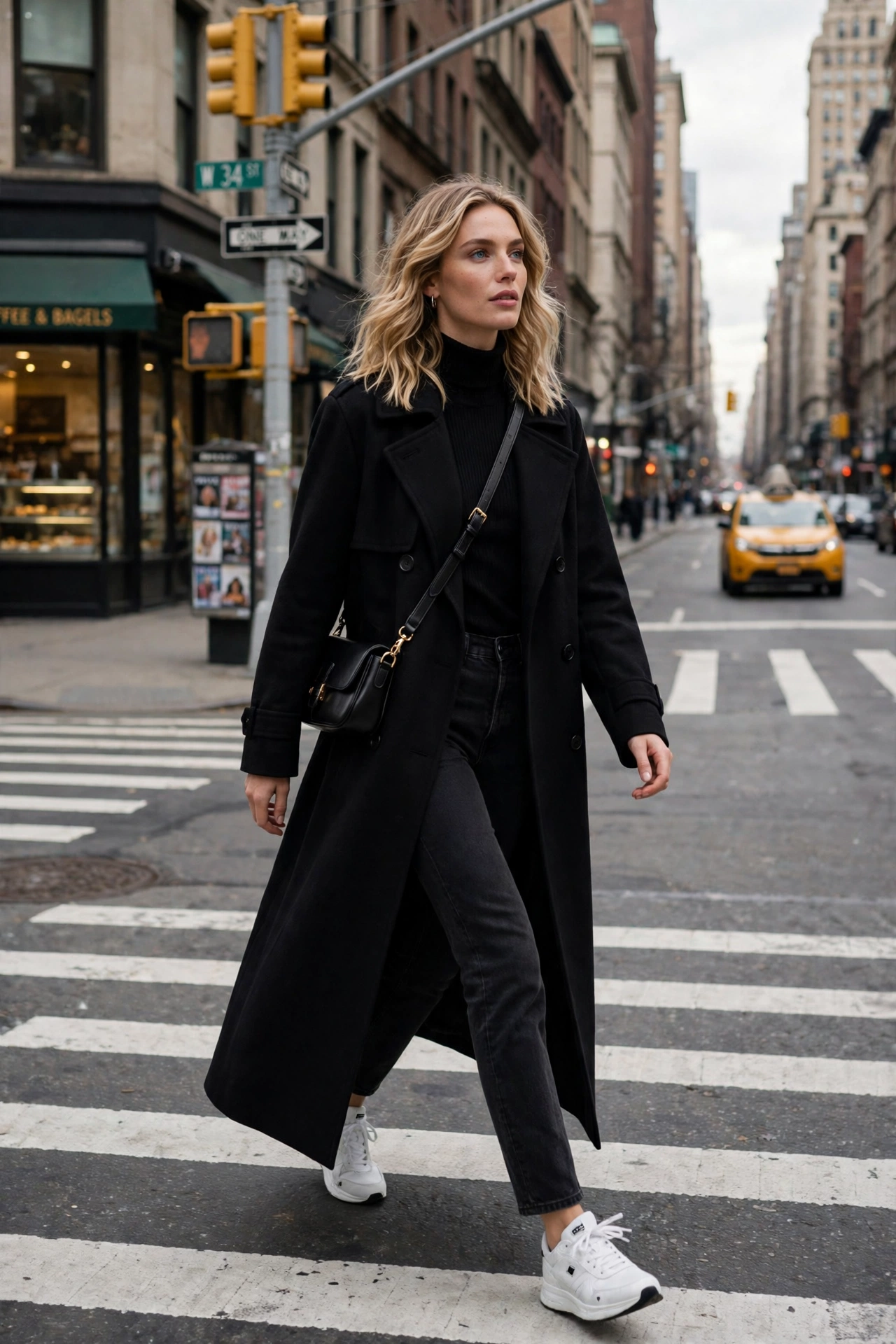
Stand on the corner of Broadway and Houston on a Tuesday morning and you’ll learn more than a month of runway coverage will teach you. A woman in a long black coat and beat-up sneakers crosses against the light with a tote and a coffee. Another comes out of the subway in wide-leg trousers, a perfect white shirt, and sunglasses in February. A third wears a vintage leather jacket over a dress, with boots that have walked ten thousand blocks. Nobody is posing. Everybody is going somewhere. That is what New York street style women have understood for decades: the outfit is not the event. The life is the event. The outfit has to keep up.
New York is a walking city, a subway city, a weather city — humid in August, windy down the avenues in January. Clothes here have to survive a delayed 6 train, a sudden Midtown downpour, and a fourteen-block walk. This guide breaks down how New York street style women do it in 2026: the uniform, the neighborhoods, the seasons, and how to steal the look in Queens or Kansas City.
1. The NYC Uniform: Black, Layers, and Shoes You Can Run In
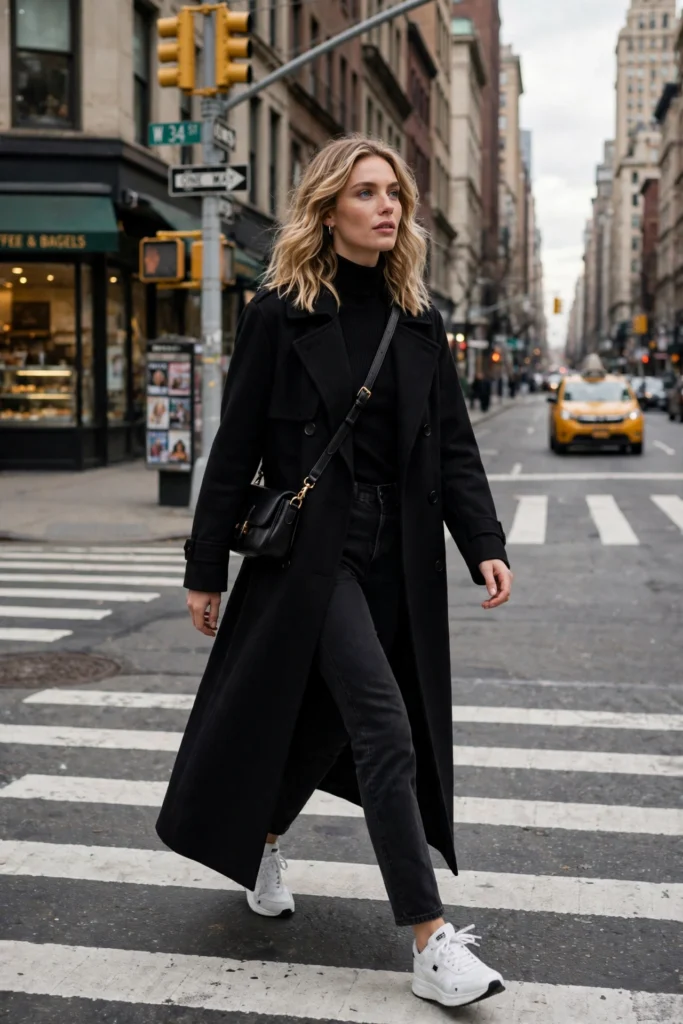
Black first, but make it texture. Ask a New Yorker to describe the city’s look and she’ll shrug and say “black.” It’s a cliché because it’s true. Black doesn’t show subway grime, doesn’t clash in a small closet, and works at 8 a.m. in a Midtown office and 8 p.m. in a West Village restaurant without a costume change. But it’s never just black. It’s texture on texture — a matte wool coat over a ribbed knit, leather boots against soft trousers, a silk scarf against a black turtleneck. If everything you own is black, navy, grey, cream, and denim, everything matches, and getting dressed is a thirty-second decision. That’s the strategy behind how New York street style women build a closet that never fights itself.
Layers for the subway, shoes for the street. In winter, street level might be 28 degrees, but a crowded downtown platform feels like a sauna in a wool coat. In summer, it’s steaming above ground and the train is refrigerated. So the build is a fitted base, a middle layer you can remove and carry, and a real outer layer. Shoes: clean white sneakers are the city’s unofficial shoe, worn with trousers and dresses. Loafers and ballet flats handle polished days, chunky boots take winter, heels are mostly for events. The famous move is the commute shoe and the office shoe — one for the pavement, one under the desk. That tote is a shoe transport system. Our guide to Los Angeles Fashion Style: How LA Women Dress Every Day describes a city where the car does the walking and heels survive just fine. Different city, different physics.
Outerwear and the bag. The 2026 rotation is consistent: a long wool coat for cold, dry days; a black or navy puffer for the brutal ones; a trench for the in-between months, April and October; and a leather jacket that’s less a purchase than a long-term relationship. Crossbody bags rule — hands free for the rail, the coffee, the phone — while totes carry a book, a water bottle, and the keys to a walk-up apartment.
2. Every Neighborhood Has Its Own Dress Code
People talk about “New York style” like it’s one thing, then visit and realize the city is five boroughs and forty fashion arguments at once. Ride the train twenty minutes and the aesthetic changes completely. That variety is much of what makes New York street style women so hard to copy with a single formula.
SoHo polish, Brooklyn personality. SoHo and the West Village are the polished downtown: long coats in camel and black, straight-leg jeans or tailored trousers, loafers, small gold jewelry, hair that looks effortless and was not. The formula — coat, knit, trouser, loafer — is boring on paper and convincing in person because everything fits like it was tailored. Williamsburg and Greenpoint flip the energy: vintage, denim, visible personality. Thrifted leather jackets from Beacon’s Closet, baggy jeans, chunky boots, beanies, dresses over pants. It must not look like you bought the whole outfit at once, even if you did. Bushwick pushes it further — more DIY, more “this was a curtain yesterday and it’s a top now, and honestly, it works.”
Uptown, downtown, and the working city. The Upper East Side leans old-money polish, younger now: ballet flats, cardigans worn as tops, headbands, tailored coats. Harlem’s legacy predates every downtown trend — Dapper Dan built an empire on 125th Street remixing luxury logos in the eighties, and its bold color and sharp tailoring never left. Sunday in Harlem is still one of America’s best fashion shows. Midtown and the Financial District have loosened: trousers and a knit, a blazer over a dress, loafers instead of pumps — decode it with our guide to Casual Outfits for Women: 20 Everyday Looks That Never Fail in America The Lower East Side keeps the edge: slip dresses with boots, leather everything. And as our roundup of Top 20 Latest Women’s Fashion Trends in the USA 2026 shows, half the national trends started as some neighborhood here dressing for itself.
3. Dressing for the Subway, the Seasons, and the Fourteen-Hour Day
Admiring the look is one thing. Surviving a New York year in it is another. Women who dress best here aren’t chasing trends. They’re solving four weather problems and one schedule problem — the practical core New York street style women rely on.
Winter and the lying spring. January and February mean avenue wind tunnels, slush at every curb, and weeks of grey light. The answer: a long puffer or wool coat, thermal layers, waterproof boots with real soles, and a hat-scarf-glove system treated as mandatory. The same woman in a puffer at 8 a.m. is in a sweater dress and heeled boots at a Midtown party at 8 p.m. — the coat check exists. Harper’s Bazaar’s street style coverage photographs the party version; the puffer version makes it possible. Spring is a liar — 70 on Tuesday, 41 with rain on Thursday — so the trench coat earns its legend, and a knit over the shoulders is insurance, not affectation.
Summer engineering, fall’s golden window. Summer humidity is a physical substance. Linen, cotton, and loose silhouettes win; tight synthetics lose by noon. Everywhere you’ll see flowy midi and maxi dresses with flat sandals, tailored shorts with an oversized shirt, linen trousers with a tank and crossbody. Black doesn’t retire — it gets lighter: a black linen dress is as New York in August as a wool coat in January. Fall is the peak: September brings Fashion Week, but October is the better show — oversized blazer, jeans or trousers, boots, and every combination clicks.
The fourteen-hour day and rain. An outfit often has to cover work, dinner, and a friend’s birthday in Ridgewood with no trip home. Solutions are small and smart: a blazer that upgrades jeans, earrings in the bag, lipstick as an entire strategy, shoes chosen for the day you actually have. Rain arrives sideways and floods the corners, so waterproof boots are permanent closet residents, umbrellas must survive avenue gusts, and trousers stay hemmed above the puddles. The city rewards preparation: you stop calling it fashion sense and call it experience, worn on your feet.
4. Steal the Look: NYC Formulas That Work Anywhere
Good news: you don’t need a Manhattan zip code, or budget, to dress like this. I have family in Ohio who dress with more New York logic than half of Manhattan, because the logic was never about the place. It’s a tight palette, real shoes, good outerwear, and knowing your own neighborhoods. These are the formulas New York street style women run on rotation, and they travel.
Four formulas on rotation. One, the downtown classic: long dark coat, black or dark-wash straight jeans, fitted knit, white sneakers or loafers, one piece of gold jewelry — it works in Chicago, Boston, and at a nice lunch in Charleston. Two, the creative Brooklyn: vintage or faux-leather jacket, relaxed jeans or a slip skirt, chunky boots, one unexpected thing, like a printed scarf or bold lip. Three, the uptown polish: tailored trousers, cardigan or fine sweater, ballet flats, structured tote, everything else quiet. Four, the evening shortcut: the black slip dress half the city owns, heeled boots, the good coat, statement earrings, done. Nobody invents a new outfit every morning; they rotate formulas and swap details.
Budget, fit, and the one personal thing. People assume this costs a fortune. Some of it does, but the backbone is available at normal prices: Zara, COS, Uniqlo, and Aritzia on bags all over the subway, plus The RealReal for resale, Beacon’s Closet and Crossroads for vintage, and Brooklyn flea markets every weekend. A $40 vintage jacket over a $15 tee reads more New York than head-to-toe designer, because the mix is the message. Fit beats labels — a tailor can make a mid-range trouser look four times its price. My cheat sheet for copying New York street style women: fit, fabric, palette, shoes, one personal signature. She’s the editor in the perfect coat, the artist in the curtain-top, the grandmother in Harlem in a hat that stops traffic. The styles couldn’t be more different. The confidence is identical.
Conclusion
How NYC women dress in 2026 isn’t a trend, and it never really was. It’s a system built by a hard city: a narrow palette that always matches, layers that answer the subway’s mood swings, shoes that respect the mileage, and outerwear that carries the outfit for months. On top of that system, neighborhoods write their own signatures — SoHo polish, Brooklyn vintage, Harlem flair, downtown edge. If you take one idea from this, take the formulas. A few reliable combinations will do more for your everyday style than any shopping spree. That’s the real lesson of New York street style women: build the blueprint, then make it yours, one well-dressed ordinary Tuesday at a time. The city just makes it visible.
Frequently Asked Questions (FAQs)
Q1: Why do so many women in New York wear black all the time?
A1: Mostly practicality. Black hides city grime and subway dirt, matches everything in a small closet, and works from an office day straight into an evening out. Women add interest through texture — wool, leather, knits, silk — rather than color, so all-black looks deliberate, not lazy.
Q2: What shoes do women in New York actually wear day to day?
A2: Clean white sneakers are the everyday default, worn with everything from trousers to dresses. Loafers and ballet flats cover polished days, chunky boots take winter, and heels are mostly for evenings. Many women commute in practical shoes and change at the office.
Q3: How expensive is it to dress in New York street style?
A3: It can be done at almost any budget. The look depends on fit, a tight palette, and good outerwear more than labels. Plenty of women mix pieces from Zara, COS, and Uniqlo with vintage finds from Beacon’s Closet or The RealReal. One good coat beats a closet of logos.
Q4: What is the difference between Manhattan and Brooklyn street style?
A4: Broadly, Manhattan — especially SoHo, the West Village, and the Upper East Side — leans polished, minimal, and tailored, with neutral colors. Brooklyn neighborhoods like Williamsburg and Bushwick lean creative and vintage-driven: thrifted pieces, relaxed denim, chunky boots, and one-of-a-kind finds. Plenty of women cross the river stylistically, too.
Q5: What do women in New York wear in summer despite the humidity?
A5: Light, loose, breathable clothing: linen trousers and dresses, cotton midi and maxi dresses, tailored shorts with oversized shirts, and flat sandals or white sneakers. Black stays in rotation, but in summer fabrics like linen. Crossbody bags, sunglasses, and a layer for over-air-conditioned trains complete it.
Q6: How can I copy NYC style if I don’t live in New York?
A6: Copy the system, not the exact outfits. Build a small palette of black, navy, grey, cream, and denim; invest in one great coat and comfortable shoes; learn three or four formulas to rotate; and add one signature, like vintage leather or bold jewelry. Tailoring makes the biggest difference.