Introduction
Office outfits for women have changed more in the last six years than in the previous thirty. The stiff suit-and-pumps formula cracked during the work-from-home era, and what replaced it is better: softer tailoring, real comfort, and room for personal style. But “relaxed” doesn’t mean “anything goes,” and that’s where most women get stuck.
I’ve worked in a corporate office in Chicago, a creative agency in Austin, and remotely from a kitchen table in Denver, and the dress codes were three different planets. Chicago wanted tailoring. Austin accepted nice jeans. The outfits here are built for that real middle — polished, professional, and clearly dressed on purpose, without a 1990s power suit in sight. You’ll find core pieces, seasonal formulas, honest dress-code guidance, and fixes for the mistakes that quietly undermine good office outfits for women. None of it requires a stylist. Let’s build a closet that makes Monday morning easier.
1. The Core Wardrobe: Pieces That Build Every Great Work Outfit
Every strong rotation of office outfits for women starts with the same backbone: well-fitting pieces that mix without thinking — the difference between calm and chaos at 7:40 a.m.
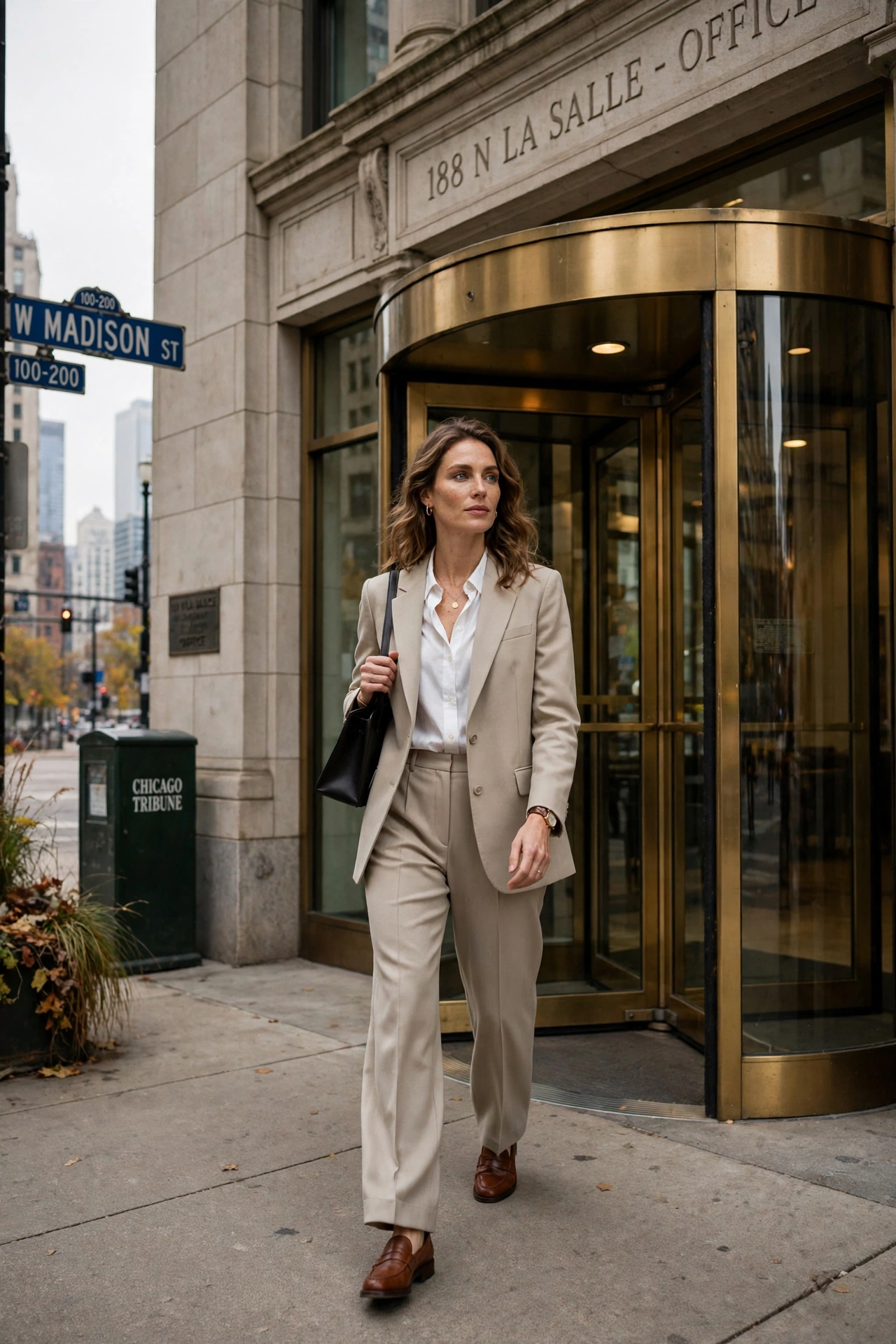
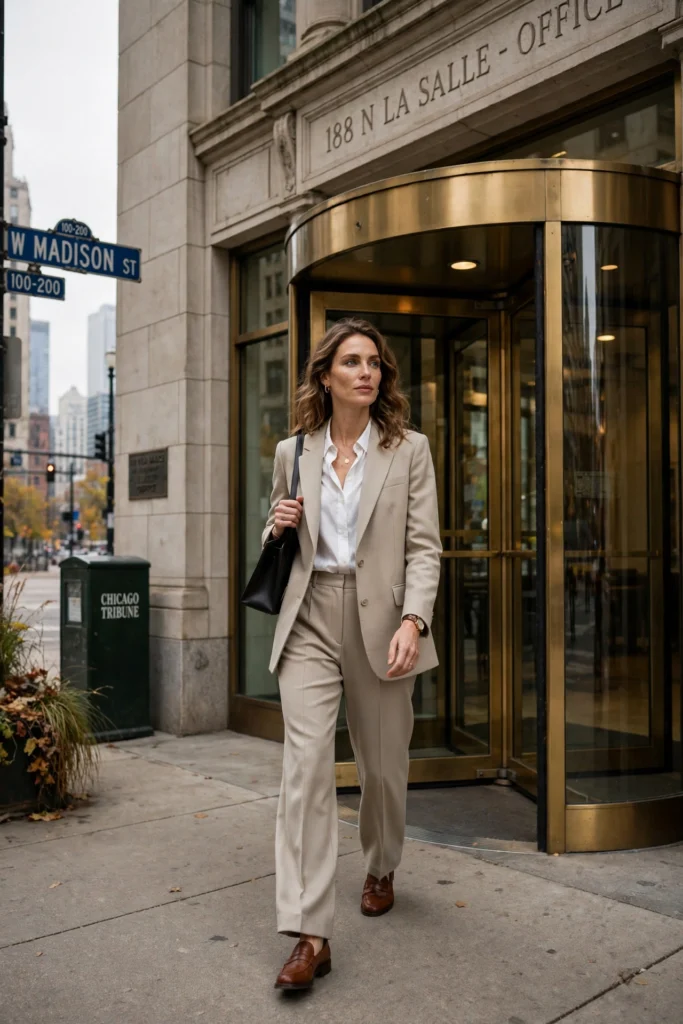
Start with tailoring. One relaxed blazer in black, navy, or a warm neutral anchors everything — over dresses, with trousers, even with dark jeans on casual Fridays. Pair it with two trousers, one wide-leg and one straight-leg, in different colors. Add a pencil or A-line skirt if skirts are your thing; plenty of women skip them entirely.
Tops do the quiet work: a slightly oversized white button-down, two silk or satin blouses, a few fine-knit sweaters, and clean shell tops for layering. Quality beats quantity — cotton-poplin and matte satin survive a full day, while an easily wrinkled blouse sabotages you by 10 a.m. If your office runs cold, a fine-gauge cardigan is money well spent.
Dresses are the fastest outfit in existence. Sheath, shirt, and knit wrap dresses in solid colors work in nearly every office in America — one dress, one pair of shoes, and you’re done. Our guide to the Best Shoes to Wear with Dresses covers pairings that stay comfortable all day.
Finish with loafers, low block heels, or pointed flats, plus one structured laptop tote that goes with everything — it will out-earn five trendy bags. Keep jewelry simple: studs or small hoops, one watch, nothing that clinks against the keyboard. Buy the best basics you can afford, in fabrics that hold their shape.
A Real Week of Outfits: Monday to Friday, Solved
Monday gets the strongest look: blazer, straight-leg trousers, silk blouse, loafers. Tuesday softens: a knit sheath dress with ankle boots or pointed flats. Wednesday is sweater day — fine-knit half-tucked into wide-leg trousers, with a belt. Thursday brings the shirt dress. Friday: dark jeans and a blazer if denim is allowed, or Tuesday’s dress with different jewelry if not. That’s five office outfits for women from roughly twelve pieces, with no repeats that actually read as repeats.
2. Outfit Formulas by Season: What to Wear All Year
Formulas beat inspiration at 7 a.m. The most reliable office outfits for women follow repeatable recipes, adjusted for weather.
Spring is layering season. Try wide-leg trousers, a silk blouse, and a trench coat with loafers — it handles a 50-degree morning and a 70-degree afternoon. Or a shirt dress with a belted cardigan and pointed flats. Keep a polished ankle boot in rotation through April — in the Pacific Northwest, it’s a year-round employee.
Summer exposes the sleeveless debate. Many offices accept sleeveless tops now, especially in the South and Southwest, but if you’d hesitate, add a light layer. Linen-blend trousers with a tucked shell top and an unlined blazer look sharp in July. Midi dresses in cotton or ponte work hardest. Avoid anything beachy, anything sheer without a layer, and flip-flops in every universe. Editors at InStyle’s work outfit coverage say the same: heat doesn’t excuse sloppy.
Fall is where work wardrobes shine: sweater dresses with tall boots, plaid blazers over knit tops, and rich colors — burgundy, forest, camel, chocolate — that look expensive in flat autumn light. Invest in tailoring now; it pays back daily.
Winter demands strategy by region. In Minneapolis or Buffalo, the coat becomes the outfit everyone sees — invest there, and in real boots that handle slush. Layer knit dresses over thin turtlenecks, and keep office shoes at your desk. Southern winters are gentler: a wool blazer and closed shoes close the deal.
Color does quiet communication, too. Navy reads trustworthy, black authoritative, warm neutrals approachable, and a single rich color confident. Our report on Top 20 Latest Women’s Fashion Trends in the USA 2026 shows where soft tailoring and chocolate brown lead the list.
Regional Realities: What “Professional” Means in Different American Cities
New York and Washington, DC run the most formal: darker colors, more tailoring, closed shoes even in summer. Chicago and Boston follow close behind. Dallas and Atlanta accept more color and dresses, while San Francisco favors clean and intentional, Los Angeles a relaxed ease, and Seattle and Portland quality basics and weatherproofing. Just adjust one dial on the same pieces: formality up for the East, color up for the South, ease up for the West.
3. Decoding the Modern Dress Code: Business Professional to Smart Casual
Nothing in American working life causes more quiet panic than a dress code nobody explains. The labels shifted after 2020, and “business casual” can mean a suit in one building and clean sneakers in the next. Here’s the honest translation for office outfits for women today.
Business professional still exists — law firms, finance, government, client-facing consulting. It means a matching suit or a tailored dress, closed-toe shoes, and conservative styling, though even there the suit has softened: relaxed cuts, knit shells, loafers instead of pumps. When you interview, dress one notch above the office’s daily standard. It’s the cheapest career signal there is.
Business casual is America’s default now, and the range is wide. Safe ground: trousers or a skirt, a blouse or fine sweater, a blazer when clients appear, no denim unless Fridays say otherwise. Our guide to Business Casual for Women in the USA has the do-and-don’t list by industry. The one-line version: if it also works at a barbecue, it needs a blazer and better shoes.
Smart casual covers startups, tech, and creative industries. Dark jeans are normal, blazers optional, and personal style gets rewarded — but this is where women slide too far. Ripped denim, gym leggings, and graphic tees miss the mark, because the “smart” half of the label is doing work. Could you meet a client who dropped in unannounced? If yes, you’re dressed right.
Remote work added the waist-up outfit: a polished top, simple jewelry, and hair done carry the meeting. My advice: dress fully anyway on big-meeting days. It changes how you sit, speak, and think. When in doubt, ask — and observe the women one level above you. Every office teaches its real dress code through them, not the handbook.
Industry by Industry: The Unwritten Rules
Finance and law stay closest to business professional — tailoring expected, denim rare. Government and healthcare-adjacent offices prize neatness and modesty: clean, covered, practical. Tech moved from hoodies back up to smart casual; its leaders wear the polished end of casual — great jeans or trousers, elevated basics, one quality layer. Media and marketing reward visible personal style, while education and nonprofits favor approachable neatness. Dress a half-step above your office’s average, and you’ll rarely be wrong.
4. The Details That Decide It: Fit, Grooming, and Common Mistakes
Two women can wear the same blazer and trousers, and one looks promoted while the other looks tired. The difference is never the clothes alone — it’s the details, which are cheap to fix.
Fit comes first, always. Tailoring is the secret weapon of every well-dressed office woman I know. Hemming trousers so they break correctly, taking in a blazer waist, shortening sleeves that swallow your hands — these $20-to-$40 alterations make mid-priced clothes look expensive. A designer suit that pulls at the shoulders looks worse than a modest one that fits.
Wrinkles come next. A five-minute steam outperforms an expensive label, so keep a steamer near your closet, check hemlines and loose buttons monthly, and retire pieces that pill or fade. Office light is fluorescent and honest. Grooming frames the rest: clean, intentional hair, neat nails, and simple makeup read as “prepared” in the same ten minutes daily. Shoes get judged more than people admit, too; scuffed heels downgrade the whole look.
The mistakes I see most: over-accessorizing, with three statement pieces fighting at once; under-accessorizing, a fine outfit with no finishing piece; dressing for the job you had in 2016; and the biggest one, buying outfits instead of pieces. Pieces that mix will always beat outfits that don’t.
Finally, confidence. The best office outfits for women are the ones you stop thinking about by 9 a.m. If you’re tugging, adjusting, or second-guessing, the outfit failed its job, however it photographs. Comfort and polish aren’t enemies — soft suits, loafers, and knit dresses exist because women demanded both.
Building the Wardrobe on a Real Budget
A professional wardrobe sounds expensive until you price what it replaces: constant, anxious, one-off shopping. Month one, fix fit. Month two, fill the biggest gap — usually the blazer or trousers. Then add one quality piece per season. Spend on the blazer, coat, tote, and shoes you stand in; save on shell tops and layering knits. Thrift stores in professional neighborhoods in DC, Boston, and Chicago suburbs stock excellent cast-off wool tailoring at a fifth of retail. Track cost per wear: $180 trousers worn forty times cost $4.50 a wear; a $40 “deal” worn twice cost $20.
Conclusion
Great office outfits for women rest on three things: a foundation of well-fitting basics, repeatable formulas for each season, and details that stay sharp under fluorescent light. The modern dress code rewards polish without stiffness — soft tailoring, comfortable shoes, breathable fabrics, and one deliberate finishing touch. Build slowly, and in the right order: fix fit first, fill foundation gaps second, and let trends in only when they pass the client test — could you meet someone important, unannounced, and feel ready?
If the answer keeps being yes, your wardrobe is doing its job. You’ll spend less, panic less on Monday mornings, and walk into every room dressed on purpose. Your 7 a.m. self will thank you, and your career will quietly notice.
Frequently Asked Questions (FAQs)
Q1: What are the best office outfits for women right now?
A1: The strongest current options are relaxed tailored suits, wide-leg trousers with silk blouses, knit or sheath dresses, and sweater-and-trouser combinations in fall. Loafers, pointed flats, and low block heels have replaced stilettos as everyday office shoes in most American workplaces.
Q2: Can women wear jeans to the office?
A2: In business casual and smart casual offices, yes — choose dark-wash, non-ripped jeans with a clean hem, and pair them with a blouse, blazer, or fine sweater. Traditional business professional offices and client meetings still call for trousers or dresses instead.
Q3: What colors look most professional for women at work?
A3: Navy, black, charcoal, and warm neutrals like camel and cream are the safest professional base. Rich accent colors — burgundy, emerald, deep teal — work well as single statement pieces, especially in fall and winter when you want one piece to carry the outfit.
Q4: How many work outfits should a woman own?
A4: A foundation of about ten mix-and-match pieces — two trousers, one skirt, one blazer, four to five tops, two dresses, and two pairs of shoes — can create two to three weeks of different outfits. Quality and fit matter far more than quantity.
Q5: Are sleeveless tops appropriate for the office?
A5: In many modern offices, yes, especially in warm climates, provided the cut is polished and modest. When you’re unsure, or when clients are present, add a light blazer or cardigan. Conservative industries still expect covered shoulders at work, particularly in formal settings.
Q6: How can I look professional on a budget?
A6: Buy fewer, better basics, shop end-of-season sales, and spend small amounts on tailoring — hemming and waist adjustments make modest clothes look expensive. Thrift stores in professional neighborhoods are excellent sources for quality blazers, coats, and wool tailoring pieces at fair prices.